The local route, priced honestly
Vietnam SIM cards for tourists
A physical SIM in Vietnam is cheap, easy and legally tied to your passport. Here is what it costs, where to buy it, and the three cases where it beats an eSIM outright.
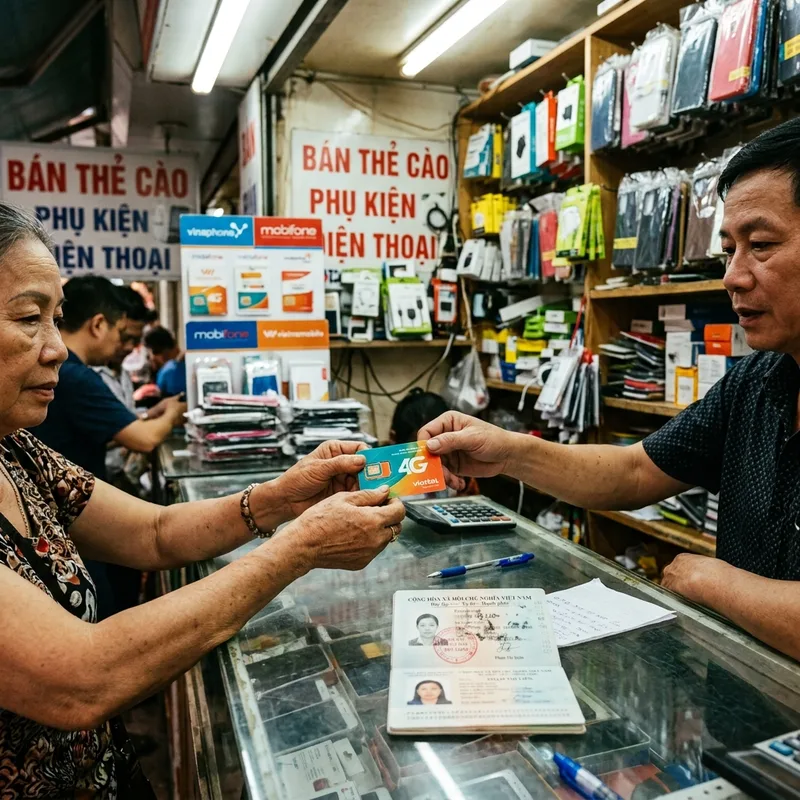
Every SIM in Vietnam is registered to a passport and this is enforced
Decree 49/2017/ND-CP requires each mobile line in Vietnam to be registered against an identity document. For a visitor that means your passport, handed across the counter, photographed or scanned, at the moment of purchase.
The process is undramatic. It takes a minute or two, the shop assistant does it, and you walk out with a working line. What matters is the consequence of skipping it.
An eSIM from a travel provider is outside all of this. You are roaming onto a Vietnamese network under an agreement your provider holds, not holding a Vietnamese line, so there is nothing to register and no passport to hand over. That is a real convenience, not just a technicality, and it is the main non-price reason to pick one.
What a Vietnam tourist SIM actually costs VND, checked September 2026
| Where you buy it | Typical price | What you get | Passport |
|---|---|---|---|
| City phone shop | 60,000–150,000 VND (≈$2–6) | The best price in the country. 15 to 30 days, daily data allowances that no travel eSIM matches on value. | Required |
| Supermarket or convenience chain | 80,000–180,000 VND (≈$3–7) | Same packages, slightly marked up, and easier to find with no Vietnamese. | Required |
| Airport counter (24h) | ≈130,000–300,000 VND (≈$5–12) | Roughly 30–50% over the city price, and staff steer you to the biggest bundle on the board. | Required |
| Reseller eSIM (Klook, Gigago) | $6–20 | A local-network profile emailed to you before you fly, pre-registered by the seller. | Not asked |
| Travel eSIM (Airalo, GigSky, Saily) | $2.99–$49 | Roaming on VNPT or an undisclosed partner. No registration, English support, refund policy. | Not needed |
VND figures are the real transaction currency at a Vietnamese counter; dollar equivalents are rounded approximations at the September 2026 rate. Travel eSIM prices are USD checkout prices from our comparison, checked September 4, 2026.
Read that table and the local SIM is unambiguously cheaper. Two to six dollars for a month of data that a travel eSIM sells for fifteen to twenty is not a close contest on price alone. What you are paying the extra for is landing connected, keeping your passport in your pocket, and having someone to email when it does not work.
Where to buy a SIM in Vietnam ranked by how much it costs you
- An official carrier store in a city. Cheapest, and the assistant will register the line properly. Viettel, Vinaphone and MobiFone all have storefronts through central Hanoi, Ho Chi Minh City, Da Nang and every provincial capital, and many sit inside large supermarkets.
- The airport counters. Ground floor of the arrivals hall at Noi Bai Terminal 2 and at Tan Son Nhat, past immigration, open 24 hours, all three carriers side by side. This is the convenient option and it costs 30 to 50 percent more. If you land at 01:00 with no data, it is worth every dong.
- A reseller, bought before you fly. Klook and similar sellers list local-network eSIMs, pre-registered, delivered by email. This is the only way to get a local network without handing over a passport, and it costs more than the counter.
- Not a street stall. Cheap, unregistered, and switched off in the next sweep. This is the one route we would tell you to skip outright.
Which Vietnamese carrier should a tourist buy? it depends on the route, not the price
Viettel
Buy this one if you leave the citiesLargest carrier at roughly 54% of the market, 4G across 98.6% of the population, 5G across 91.2%. It is the only network with dependable service on the Ha Giang loop, in the Sapa valleys, around Cao Bang and down the Mekong side channels. The Viettel page covers buying one, including online before you fly.
Vinaphone (VNPT)
Fine, and what your travel eSIM already isThe state-owned number two, matching Viettel for speed in cities and thinner outside them. If you already carry an Airalo or Holafly eSIM you are on this network, so buying a Vinaphone SIM as well buys you almost nothing.
MobiFone
Only if the shop is the one in front of youSolid in urban Vietnam, the first of the three to thin out on a provincial road. It runs a tourist-facing app called Hi Vietnam. There is no strong reason to choose it over Viettel at the same price, and the price is the same.
The short version: if you are buying a local SIM at all, the reason is usually coverage, and if the reason is coverage the answer is Viettel. Buying Vinaphone alongside a travel eSIM is buying the same network twice.
SIM card or eSIM for Vietnam? three cases each
Buy a local SIM if
You want a +84 phone number that works for Zalo, a bank, a landlord or a booking system. No travel eSIM on our list gives you one.
You are staying more than a month, where the price gap stops being a rounding error and starts being real money.
Your phone has no eSIM support. Dial *#06# and look for an EID; no EID means the decision is made for you.
You are going north and want Viettel, which no travel eSIM sells.
Buy a travel eSIM if
You want to land connected, with Grab working before you reach the taxi rank.
You would rather not hand over your passport at a counter, or queue at 01:00 after a long flight.
You want English-language support and a refund policy when something does not activate.
Your trip is two weeks of cities and coast, where the total saving from going local is about twelve dollars.
If the eSIM column is the one that describes you: GigSky is the cheapest at the sizes most people buy, 5GB for $10.29 and 10GB for $16.79, and gives away 100MB for seven days so you can test the signal first. Airalo costs $1.21 more at 10GB and is the only one that publishes its Vietnamese network.
See GigSky plans See Airalo plans Compare all six providersWhat goes wrong with Vietnam SIM cards the four we hear about
| The problem | What actually happened | Avoid it by |
|---|---|---|
| Service dies on day nine | The SIM was never registered to anybody, and the carrier deactivated it in a routine sweep. | Only buying where your passport is asked for. |
| "Unlimited" runs out | Vietnamese tourist packs are usually a daily allowance, often 5GB a day, not a monthly bucket. Past the daily figure the speed drops. | Reading the daily number, not the word on the poster. |
| Paid triple at the airport | The counter offered the largest bundle first and there was no menu of alternatives. | Asking for the cheapest 30-day data pack by name, or buying in town the next day. |
| Phone shows no service near the border | Handsets in Ha Giang and Cao Bang latch onto Chinese networks across the frontier. | Setting network selection to manual and picking the Vietnamese carrier by hand. Setup and fixes. |
Questions about Vietnam SIM cards
How much should I pay for a SIM card in Vietnam?
Between 60,000 and 200,000 VND, roughly $2 to $8, for 15 to 30 days with a daily data allowance. Anything much above that is an airport price or a markup. Airport counters typically run 30 to 50 percent over the city price for the identical package.
Do I need my passport to buy a SIM card in Vietnam?
Yes. Decree 49/2017/ND-CP requires every line to be registered to an identity document, and for a visitor that is a passport. The shop handles the paperwork in a couple of minutes. A SIM sold without asking for it is an unregistered line and can be cut off without warning.
Can I buy a Vietnam SIM card at the airport?
Yes, and unlike some countries the arrival story here genuinely works. Viettel, MobiFone and Vinaphone all keep 24-hour counters in the arrivals hall past immigration at Noi Bai and Tan Son Nhat. You will be online in ten minutes and you will pay a premium for it.
Which SIM card is best for tourists in Vietnam?
Viettel, if you are leaving the main cities: it has the widest coverage by a distance and is the only network that works reliably in the northern mountains. If you are staying on the coast road, all three are fine and the cheapest package on the counter is the right answer.
Is a SIM card or eSIM better for Vietnam?
A local SIM is cheaper and gives you a +84 number. A travel eSIM means landing connected with no passport and no queue, and costs maybe twelve dollars more across a two-week trip. For most short visits the eSIM wins on convenience; for a month or more, or for a Viettel-only route, the local SIM wins.
Can I use my US cell phone in Vietnam?
If it is unlocked, yes, with either a local SIM or an eSIM. Roaming on your US plan works too and costs about $12 a day on AT&T or Verizon day passes, which is more than a month of any option on this page. Check the phone is unlocked before you travel; a locked handset takes neither a Vietnamese SIM nor an eSIM.
How long does a Vietnam tourist SIM last?
Most tourist packages run 15 or 30 days from activation, with a daily data allowance rather than a single monthly bucket. Top-ups are sold in every phone shop and through the carriers' apps, so extending is easy once the line exists.
Or skip the counter entirely
A travel eSIM installs at home and works the moment you land, with no passport and no queue. GigSky is the cheapest of the four we compare at the sizes most people buy, and it gives away 100MB for a week so you can test the signal before spending anything.
See GigSky Vietnam plansSources & freshness: Tourist SIM pricing from current Vietnamese carrier packages and 2026 traveler guides, in VND with rounded dollar approximations, September 4, 2026. Airport counter locations and 24-hour opening verified against carrier and airport information for Noi Bai Terminal 2 and Tan Son Nhat. Registration requirement: Decree 49/2017/ND-CP. Travel eSIM prices from our own comparison, checked September 4, 2026.